
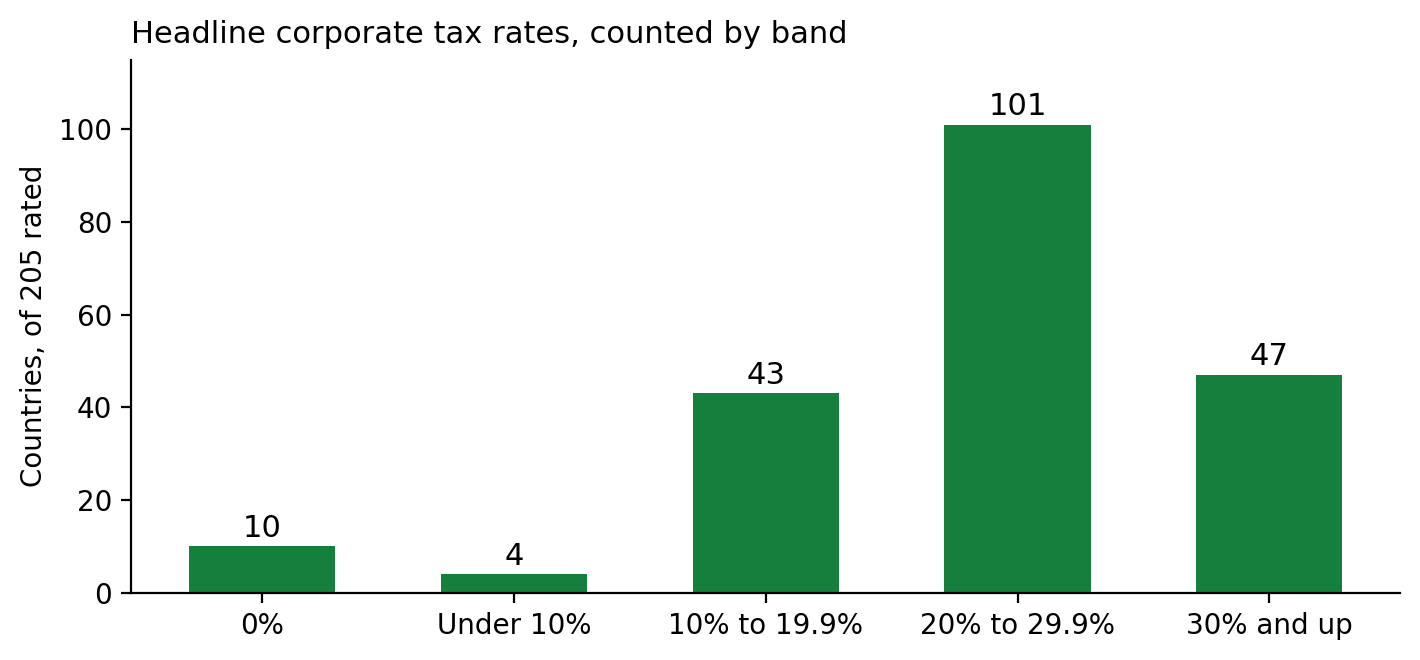
Ten. Of the 205 countries in our database with a headline corporate tax rate, ten still charge 0%: the Bahamas, British Virgin Islands, Cayman Islands, Guernsey, Isle of Man, Jersey, Marshall Islands and Vanuatu at a flat zero, plus Bahrain and Bermuda as tiered zeros that already carry a top-up tax for the largest groups. Below the crowded middle of the table (the median country charges 25%, and 101 countries sit between 20% and 30%) there is almost nothing left: only four countries in the world price themselves between zero and ten, Switzerland at 8.5% and Hungary, the UAE and Barbados at 9%.
| Country | Headline rate | Form |
|---|---|---|
| Bahamas | 0% | Flat |
| British Virgin Islands | 0% | Flat |
| Cayman Islands | 0% | Flat |
| Guernsey | 0% | Flat |
| Isle of Man | 0% | Flat |
| Jersey | 0% | Flat |
| Marshall Islands | 0% | Flat |
| Vanuatu | 0% | Flat |
| Bahrain | 0% | Tiered (top-up tax for large groups) |
| Bermuda | 0% | Tiered (15% for large groups since 2025) |
| Switzerland | 8.5% | Lowest nonzero rate recorded |
| Hungary | 9% | Flat |
| United Arab Emirates | 9% | Introduced 2023 |
| Barbados | 9% | Reformed upward |
Killed by publicity
The zero rate is not dying because it stopped working. It is dying because everyone found out. A generation ago, knowing which island charged nothing, and how to use it, was specialist knowledge sold by advisers. The internet made it common knowledge, and common knowledge brought volume: founders, remote companies and funds piled into the same handful of low-tax doors. Volume brought visibility, and visibility brought politics. A loophole used by a few hundred companies is a footnote; the same loophole used by hundreds of thousands is a headline, and headlines are what finance ministries answer.
The exits have already started
The pattern is visible in the recent movers. The UAE, the modern era's flagship low-tax hub, introduced a federal corporate tax of 9% in 2023, its first. Bermuda kept a zero headline but added a 15% tax from 2025 for the large multinational groups that the new global minimum tax targets, and Bahrain added a top-up tax on the same logic. Behind all three sits the OECD global minimum: more than 140 jurisdictions agreed that the biggest groups pay at least 15% somewhere, which removes the prize for offering zero. Each country that starts taxing makes the remaining zeros more crowded, and more crowded makes them easier to tax next. The opportunity is consumed by its own popularity.
What is left, and for whom
For a small company, the ten zeros are still real: the global minimum bites on groups with revenues above 750 million euros, not on a two-person software firm. But the direction of travel is one-way, and it rhymes with what the banking data shows elsewhere in this market: the door stays open while the welcome wears out, through harder bank onboarding, more reporting, and now, increasingly, an actual tax rate. Anyone building a long-term structure on a zero should price in the possibility that the zero is a temporary feature of a place, not a permanent one.
Counts from the CorpTaxRates database of 212 countries, headline rates for 2026, verified September 14, 2026. Headline rates are the standard statutory rate; effective rates vary with allowances, sectors and group size. This is information, not tax advice.