
Bulgaria taxes company profits at a flat 10 percent. There is no higher band for large companies and, in the dataset this site maintains, no separate small business rate: one rate, applied to profit, verified on September 14, 2026. That simplicity is the whole story, and it is why Bulgaria keeps landing near the cheap end of every European tax table.
Bulgaria corporate tax rate: 10 percent, in brief
- Headline rate: 10 percent, flat.
- Small business rate: none recorded. The same 10 percent applies at every size.
- EU position: second lowest of the 27 member states, behind only Hungary at 9 percent.
- Nearest neighbours on rate: Ireland at 12.5 percent, Cyprus at 15 percent, Romania at 16 percent.
- Dataset status: verified September 14, 2026, against the recorded official source.
Who pays the 10 percent
The rate applies to company profit. A business operating in Bulgaria pays 10 percent on the profit it makes, and the dataset records no tiers or industry bands at the headline level to memorise before the calculation starts. Compared with the tiered systems elsewhere in this dataset, where the first slice of profit is taxed at one rate and the rest at another, Bulgaria's structure is the simplest in the European Union: the rate you read is the rate that applies.
How Bulgaria compares inside the EU
From the same dataset, the bottom of the EU table and its middle and top for scale:
- Hungary: 9 percent, the only member state below Bulgaria.
- Bulgaria: 10 percent.
- Ireland: 12.5 percent on trading income.
- Cyprus: 15 percent, raised from 12.5 percent on January 1, 2026.
- Romania: 16 percent. Lithuania: 17 percent. Croatia: 18 percent.
- The median member state: 22 percent, more than double Bulgaria's rate.
- Germany: a typical combined 30 percent. Malta: 35 percent, the EU's highest.
The head-to-head with the one country below it is its own comparison: Hungary vs Bulgaria Corporate Tax. The full regional table is in Corporate Income Tax Rates in Europe.
A 100,000 euro profit, worked through
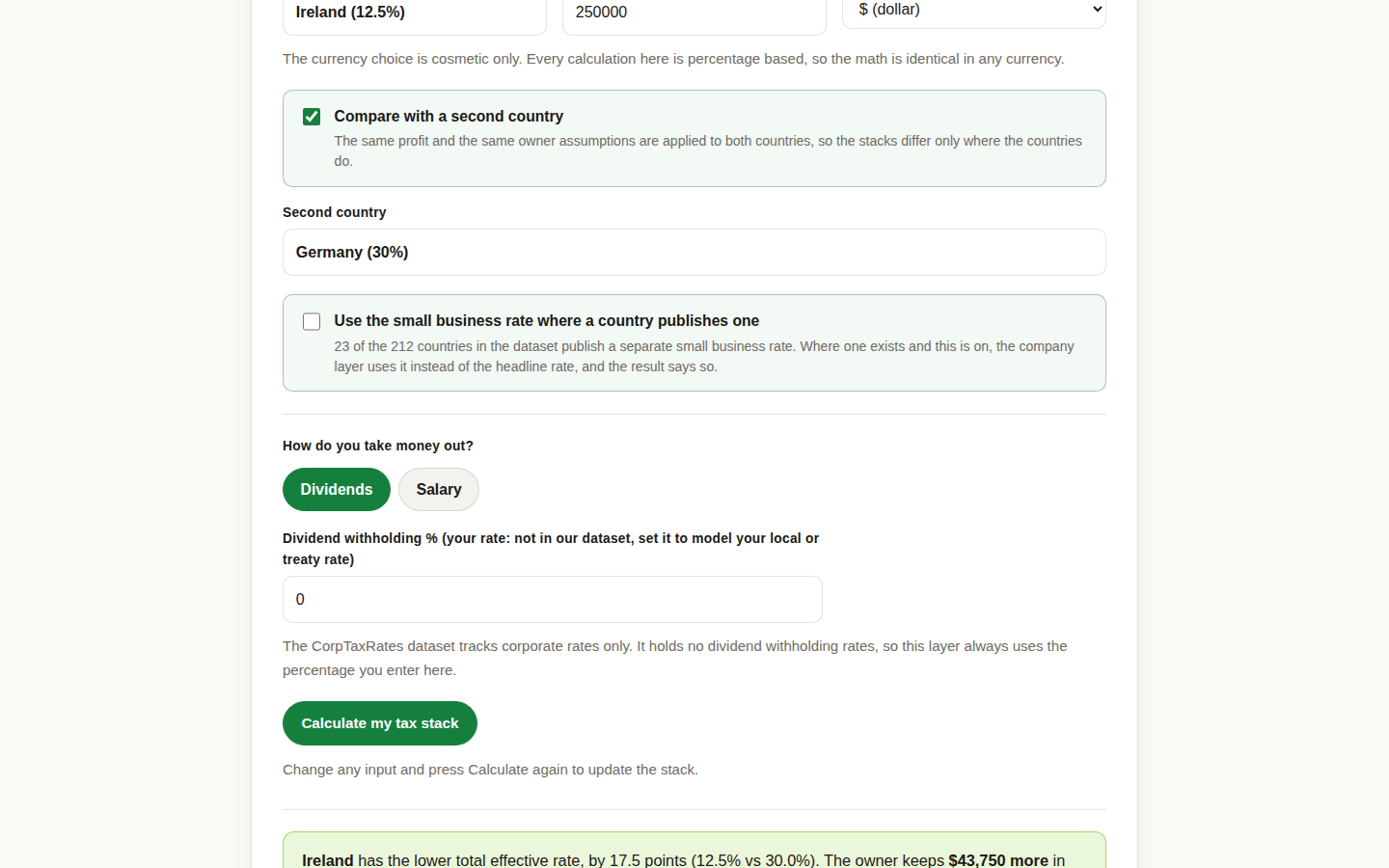
At the headline rate, a company making 100,000 euro of profit in Bulgaria pays 10,000 euro of corporate tax and keeps 90,000 euro. The same profit in Hungary pays 9,000 euro; in Romania it pays 16,000 euro; at the EU median rate of 22 percent it would pay 22,000 euro. That is the first layer. What the owner eventually takes home is a second calculation, driven by how profits are paid out, and it is the layer founders most often forget to model. The TaxStack Calculator runs both layers with your own payout assumptions, and the TaxStack walkthrough shows the method on real examples.
What the 10 percent does not settle
A headline rate is a statutory number, not an effective one, and the gap between the two is where budgets go wrong; the distinction is laid out in Statutory vs Effective Corporate Tax Rate. Bulgaria's flat 10 percent also sits below the 15 percent global minimum, which matters only at the largest scale: groups in scope of the minimum tax rules face top-ups that compress headline gaps like this one. For the small and mid-size companies that actually choose between Sofia and its neighbours, the 10 percent is the rate that shows up in the accounts.
Questions founders ask
Is there a lower Bulgarian rate for small companies?
Not in the dataset. Bulgaria records a single flat rate of 10 percent with no separate small business rate, unlike the 23 jurisdictions in the dataset that do publish one.
Is Bulgaria the cheapest country in the EU?
Second cheapest. Hungary's 9 percent is the only lower headline rate among the 27 member states, and the two are compared directly in Hungary vs Bulgaria Corporate Tax.
How current is the 10 percent rate?
It is the rate recorded for 2026 in this site's dataset, verified on September 14, 2026. Rates do change, Cyprus moved this year, which is why the dataset is rechecked rather than assumed.
Check your own numbers
Run Bulgaria, Hungary and your current country through the TaxStack Calculator on the same profit and payout pattern, and the comparison stops being a headline and becomes a number you can plan around. If you would rather talk it through, get an intro.