
For a small company, headline international corporation tax rates are often the wrong numbers. Our dataset of 212 jurisdictions records a separate small business rate for 23 countries, and in several of them the gap between the headline and the small business rate is bigger than the gap between entire tax havens and high-tax states. A lookup app that shows only the headline is not simplifying your decision. It is reversing it.
The gaps that change decisions
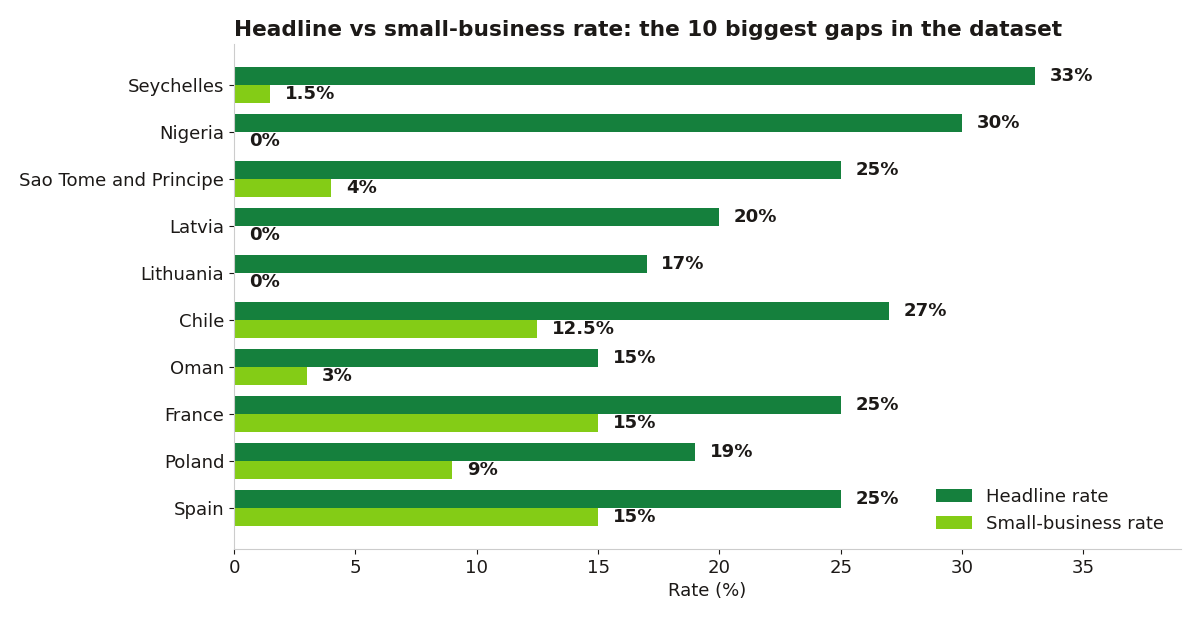
The widest gaps in the dataset are dramatic. Nigeria charges 30% headline and 0% for small companies under its 2025 Tax Act, subject to turnover and asset ceilings. Lithuania charges 17%, but qualifying small companies pay 0% for their first two years and 7% thereafter. Poland pairs a 19% headline with a 9% small taxpayer rate. Hong Kong's two-tier system charges 8.25% on the first HKD 2 million against a 16.5% headline, and the United Arab Emirates charges 9% only above AED 375,000 of taxable income, with 0% below it. One honest caution from the chart: the Seychelles figure of 1.5% is a presumptive turnover tax for very small businesses, a different kind of levy, which is itself the lesson. Small business rates come in different species, and a good lookup says which species each one is.
What to demand from a lookup app
Dated data. Rates change yearly; Lithuania's headline itself rose from 16% to 17% for 2026. No date on the rate, no trust in the rate. The small business tier shown next to the headline, always. The United Kingdom charges 25% headline and a 19% small profits rate on profits up to GBP 50,000; Canada pairs a 15% federal headline with a 9% federal small business rate. An app that hides those behind a premium tier or a footnote is steering you with half the map. Statutory and effective labeled separately, and local taxes noted: Germany's municipal trade tax and similar local layers are where small founders get surprised, because no headline includes them. The red flags are the mirror image: undated tables, one number per country, and 0% headlines with no mention of substance rules.
Three traps inside small business rates
Temporary rates. Chile's 12.5% small business rate is real but time-boxed: it applies to the 2025 to 2027 period under its ProPYME regime, while the permanent SME rate is 25%. A lookup that shows 12.5% without the expiry is setting a calendar trap. Different species. Latvia's 0% is not a small business rate at all in the usual sense: its 20% applies only to distributed profits, so retained profit is untaxed for companies of every size. Seychelles' 1.5% is a presumptive tax on turnover, not on profit, which can cost a low-margin business more than a higher rate on profit would. Qualification cliffs. Nigeria's 0% turns on turnover and asset ceilings, and the United Kingdom's 19% small profits rate phases out through marginal relief up to GBP 250,000 of profit. Near a cliff edge, the lookup gives you the rate on both sides; only your actual books say which side you are on.
The toggle test, on our own calculator
Our TaxStack Calculator has a small business rate toggle built into its main screen, which is the feature to test any rival against. Pick Poland, enter a modest profit, and flip the toggle: 19% becomes 9%, and the ranking of Poland against its neighbors changes on the spot. Do the same in Lithuania or the UAE and the small business treatment, not the headline, does all the work. If a lookup app cannot show you both numbers side by side, it is a big-company table wearing a small business label.
The lookup tells you the rate. It does not tell you whether you qualify, what to file, or what your home country does about the foreign company, and that last mile is advisor territory, which is why this site pairs its database with vetted advisor intros. Start with the counted version of the small business landscape in small business corporate tax rates by country, then sanity-check any finalist country against what the headline rate hides at the low end of the table.